Skip to product information
1 of 4

LuckyCharms.Shop

Blessing Eight Auspicious Symbols Car Hanger | Tibetan Buddhist Protecting Charm for Vehicle

Blessing Eight Auspicious Symbols Car Hanger | Tibetan Buddhist Protecting Charm for Vehicle

⭑Protection⭑Luck⭑Wealth⭑Health⭑

Regular price $9.90 USD
Regular price $14.99 USD Sale price $9.90 USD
Promo Sold out
Shipping calculated at checkout.
Style
Quantity

MEANING OF BLESSING & EMPOWERMENT

Blessing

In religions such as Buddhism and Taoism, Blessing is regarded as an important ritual. Through specific religious ceremonies - such as the recitation of scriptures and mantras by eminent monks or senior Taoist priests - sacred power is bestowed upon objects, endowing them with special religious significance and spirituality.

Blessing is mostly a "one-time" ritual. An object only needs to be blessed once; once the ritual is completed, its identity as a "sacred carrier" is established, and there is no need for repeated blessing afterward (unless it "loses its sacredness" under special circumstances, such as being damaged, contaminated with filth that cannot be purified).

For wearers, blessed objects provide psychological comfort and spiritual sustenance - they are believed to have effects such as blessing and warding off evil, which can bring people psychological comfort and a sense of security. When people face difficulties and challenges in life, they trust that the power of the blessed object can help them get through hardships, thereby gaining spiritual support and sustenance, and enhancing their inner confidence and courage.

Empowerment

Empowerment is an important concept in religions such as Buddhism and Taoism, with its core revolving around "energy endowment" and "spiritual guidance". Emphasis is placed on "transmitting power and providing protection/support", not limited to "endowing identity". Instead, it leans more towards transmitting "aspirational power", "spiritual power", or "positive mindfulness energy" in religion through rituals, to provide "empowerment, assistance, or purification" to the target (a person, object, or space) - without altering the target's fundamental attributes (for example, daily objects remain usable after being empowered).

Empowerment emphasizes the "dynamic energy connection": essentially, it is the " connection between religious power and objects”, which can be both external protection and internal awakening.

Empowerment is often a “repeatable, ongoing" ritual: the object can receive the empowerment repeatedly, for example, people can pray for peace blessing once a month, and the Buddha beads they wear in daily life can be strengthened by asking their master to recite sutras multiple times; The scale of the empowerment can be large or small, ranging from grand rituals presided over by eminent monks or priests to brief personal recitations.


MAJOR FAMOUS BUDDHIST SACRED SITES IN CHINA

 Buddhist Sacred Sites

1. Mount Wutai (Wutai County, Xinzhou, Shanxi Province)
With an altitude of 3058 meters and 47 existing monasteries, it has been revered as the manifested sacred site of Manjushri Bodhisattva since the Northern Wei Dynasty, and is also known as "Mount Qingliang".

2. Mount Emei (Emeishan City, Leshan, Sichuan Province)
From the Golden Summit, you can overlook the "Silver World". It has been the sacred site of Samantabhadra Bodhisattva since the Jin Dynasty, and was listed as a UNESCO World Cultural and Natural Heritage Site in 1996.

3. Mount Putuo (Putuo District, Zhoushan, Zhejiang Province)
Known as the "Buddhist Kingdom on the Sea and Sky", it became the manifested sacred site of Avalokiteśvara Bodhisattva after the Tang Dynasty legend of the "Unwilling-to-Leave Guanyin". At its heyday, there were 82 temples and nunneries here.

4. Mount Jiuhua (Qingyang County, Chizhou, Anhui Province)
It is the sacred site of Kṣitigarbha Bodhisattva, with its main peak Shihwang Peak standing 1342 meters high. There are more than 80 existing temples, and it is hailed as "the First Mountain in Southeast China".

5. Mount Xuedou (Fenghua District, Ningbo, Zhejiang Province)
It is the place where Budai Monk (the incarnation of Maitreya Bodhisattva) passed away. In 2008, the world's tallest outdoor bronze statue of Maitreya Buddha (56.74 meters high) was built here, and it is revered as the sacred site of Maitreya Bodhisattva.

6. Lingyin Temple (West Lake District, Hangzhou, Zhejiang Province)
Founded in the first year of Xianhe in the Eastern Jin Dynasty (326 AD), it has a history of over 1700 years and is one of the oldest and largest Chan Buddhist monasteries in the Jiangnan region. The 33.6-meter-high Mahavira Hall enshrines a 24.8-meter wooden seated statue of Sakyamuni, which is the largest wooden seated Buddha in China. In front of the temple, the Feilai Peak Grottoes preserve more than 470 stone carvings dating from the Five Dynasties to the Yuan Dynasty. Together with the temple, it is included in the "West Lake World Cultural Heritage Site" and is known as the "Crown of Buddhist Kingdoms in Southeast China".

7. Qixia Temple (Mount Qixia, Qixia District, Nanjing, Jiangsu Province)
Built in the second year of Yongming in the Southern Qi Dynasty (484 AD) when Ming Sengshao donated his residence for the temple construction. Emperor Wen of the Sui Dynasty ordered the erection of a Śarīra Stupa here. During the Tang Dynasty, it was ranked among the "Four Great Monasteries Under Heaven" together with Lingyan Temple, Yuquan Temple and Guoqing Temple, and is recognized as the ancestral home of the Three Treatises School of Buddhism.

8. Jiming Temple (East Foot of Jilong Mountain, Xuanwu District, Nanjing, Jiangsu Province)
First constructed in the first year of Yongkang in the Western Jin Dynasty (300 AD), it was the foremost among the "480 Temples of the Southern Dynasties" and has long been honored as the "First Temple of the Southern Dynasties". Rebuilt and renamed "Jiming Temple" in the 20th year of Hongwu in the Ming Dynasty (1387 AD), it is the only thousand-year-old ancient temple in Nanjing that retains its original location and is known as the "Crown of Buddhist Temples in Jinling".

9. Potala Palace (Red Hill, Chengguan District, Lhasa, Tibet Autonomous Region)
First built in the 7th century during the reign of Songtsen Gampo, its existing main structure was rebuilt and expanded in the 17th century by the 5th Dalai Lama. Situated at an altitude of 3700 meters, it is the world's highest and largest palace-fortress-style Tibetan religious complex. The 13-story main building stands 117 meters tall, divided into the Red Palace and the White Palace. Integrating palaces, stupas, Buddha halls, scripture colleges and monk dormitories, it houses 8 stupas of Dalai Lamas, over ten thousand Buddha statues, and invaluable cultural relics such as the *Palm-Leaf Scriptures*. Listed as a UNESCO World Cultural Heritage Site in 1994, it is praised as the "Pearl on the Snowy Plateau".

10. Kumbum Monastery  (Lusha'er Town, Huangzhong District, Xining City of Qinghai Province)
As one of the six principal monasteries of the Gelugpa Sect (also known as the Yellow Hat Sect) of Tibetan Buddhism, the monastery was expanded around 1380 on the basis of a stupa built at the birthplace of Master Tsongkhapa. Its Tibetan name is Gumbum Jampaling, which translates to "Maitreya Continent with One Hundred Thousand Buddha Statues". The Butter Sculptures, Murals and Appliqué Embroidery here are collectively known as the "Three Artistic Wonders" of the monastery, representing the peak of Tibetan religious art. Every year, the four major annual religious ceremonies attract hundreds of thousands of believers. These believers come to practice full-body prostrations and scripture circumambulation, making the monastery an ideal place for outsiders to closely experience the precepts, theological colleges and religious rituals of the Gelugpa Sect.

11. Yarchen Gar (Acha Town, Baiyu County, Garzê Tibetan Autonomous Prefecture, Sichuan Province)
Established in 1985, Yarchen Gar is a famous ascetic practice center of the Nyingma Sect, also known as the Red Hat Sect, of Tibetan Buddhism. It has gained widespread fame for the retreat practice of Dzogchen's "Chöchö and Thogal". The "Nuns' Island" on the east bank of the Changqu River is a prominent feature of Yarchen Gar. Nearly 20,000 female practitioners live and practice here, making it the largest concentration of female Buddhist practitioners worldwide. On the west bank of the river lies the practice area for male practitioners. The monastery enforces very strict religious precepts, and behaviors such as drinking alcohol, smoking and eating meat are strictly prohibited here.

The above-mentioned sites are the most representative Buddhist sacred places in China today. As centers of religious belief, they are also UNESCO World Heritage Sites or key national cultural relic protection units, serving as ideal destinations for pilgrimage, academic research, and cultural tourism.

MAJOR FAMOUS TAOIST SACRED SITES IN CHINA

Top 10 Ancestral Courts of Taoism

1. Mount Wudang (Danjiangkou, Shiyan, Hubei Province)
It is the sacred site of Zhenwu Emperor and an imperial temple, as well as the birthplace of the Wudang School founded by Zhang Sanfeng. The cluster of Ming Dynasty palaces and temples, including Zixiao Palace and the Golden Summit, is a UNESCO World Cultural Heritage Site.

2. Mount Longhu (Guixi, Yingtan, Jiangxi Province)
It is the ancestral court of the Zhengyi School and the birthplace of Heavenly Master Taoism, and was the hereditary residence of the 1st to 63rd Heavenly Masters. The Danxia landform of the Luxi River and the hanging coffins are collectively known as its "Three Wonders".

3. Mount Qiyun (Xiuning, Huangshan, Anhui Province)
Honored by Emperor Qianlong with the inscription "The First Famous Mountain in Jiangnan", it is a sacred place of the Quanzhen School. The temple complex on Yuehua Street and more than 500 cliff carvings showcase the cultural feature of "the Integration of Three Religions".

4. White Cloud Temple, Beijing
It is the ancestral court of the Longmen Sect of Quanzhen Taoism and the residence of Qiu Chuji, known as the "First Monastery of Quanzhen Taoism". More than ten palaces and halls built during the Ming and Qing dynasties stand along its central axis.

5. Chongyang Palace, Mount Zhongnan (Zu'an Town, Huyi District, Xi'an, Shaanxi Province)
It is the place where Wang Chongyang practiced Taoism and passed away, revered as the "Ancestral Court Under Heaven" of Quanzhen Taoism, with its palace buildings and stone tablet forest well-preserved.

6. Yongle Palace, Ruicheng (Yuncheng, Shanxi Province)
It is the hometown of Lü Dongbin, one of the largest existing Yuan Dynasty Taoist palaces in China, famous for its massive mural *The Procession of the Cloud Immortals*.

7. Mount Heming, Chengdu (Dayi, Sichuan Province)
It is the birthplace of Taoism where Zhang Daoling founded the religion, now serving as the fixed main venue of the China Taoist Culture Festival.

8. Heavenly Master Cave, Mount Qingcheng (Dujiangyan, Sichuan Province)
Known as the "Fifth Heavenly Cave" where Zhang Daoling preached Taoism, it is a convergence point of the Quanzhen and Zhengyi Schools. With lush green mountains and a well-preserved ancient temple complex, it is recognized as a renowned ancestral court of Taoism.

9. Taiqing Palace, Mount Laoshan (Qingdao, Shandong Province)
It is the "Second Monastery of Quanzhen Taoism" and the setting of Pu Songling's story *The Taoist Priest of Laoshan*. Facing the Yellow Sea, it features a unique integration of Taoist palaces and the mountain-sea landscape, and is widely acknowledged as a major ancestral court of Taoism.

10. Taiqing Palace, Shenyang (Shenyang, Liaoning Province)
It is the center of Quanzhen Taoism in Northeast China, built by imperial order during the Qing Dynasty. With a grand scale, it is the most prosperous public Taoist monastery outside the Shanhai Pass and is recognized as an important ancestral court of Taoism.

The above-mentioned sites are the most representative Taoist sacred places in China today. As centers of religious belief, they are also UNESCO World Heritage Sites or key national cultural relic protection units, serving as ideal destinations for pilgrimage, academic research, and cultural tourism.

SHIPPING

We ship to almost all countries worldwide

You can enjoy free shipping on orders over US$69

We cover the full cost of all import tariffs and duties. There are no hidden fees — the price you see is the only price you pay.

Processing Times
Our processing time takes roughly 1-3 business days. In other words, from the moment you place your order, we will require 1-3 business days to prepare your package for delivery.

Shipping Times
Delivery takes roughly 5-14 business days, barring in mind any extended public holidays there may be delivery delays.


RETURN & EXCHANGE

We know the importance of a hands-on experience, so we offer a 30-day money back guaranteed return policy beginning from the day you receive the delivery.

If you need to exchange it for the same item, send us an email.

Note: for more information, please see our Return & Exchange Policy.

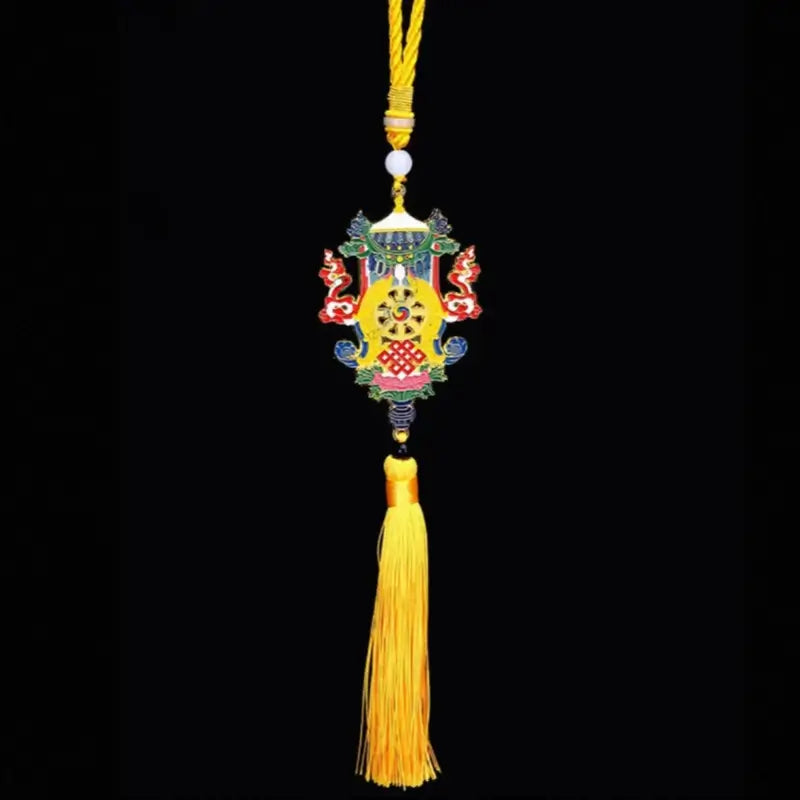
Eight Auspicious Symbols Car Hanger | Tibetan Buddhist Protecting Charm for Vehicle

Crafted with gold-plated alloy and intangible cultural heritage enamel craftsmanship, this ornament features a bright color palette and substantial texture. Adorned with a Chinese knot clasp, jade bead accents, and long plush tassels, it blends traditional elegance with exquisite artistry.

3 Auspicious Styles (each corresponds to a sacred Tibetan Buddhist symbol):

  • Style A: Dharma Wheel
  • Style B: Precious Umbrella
  • Style C: Lotus Flower

Perfect for hanging on car rearview mirrors, decorating home entrances, gifting as a Chinese-style present, or collecting by Tibetan culture enthusiasts.

This ornament is a dual embodiment of beauty and blessings: each of the Auspicious Eight Treasures carries a unique wish — the Dharma Wheel symbolizes "wisdom and smooth progress"; the Precious Umbrella safeguards "peace and tranquility"; the Lotus Flower represents "purity and auspiciousness." Hung in your car, it enhances the interior elegance with vibrant enamel while adding a sense of safety to your journeys; placed at home, it becomes a focal point that infuses your space with Chinese Zen charm.

Every enamel piece in this collection boasts one-of-a-kind color blending and intricate details. Whether you're treating yourself to safe travels or gifting it to loved ones with wishes of "perpetual good fortune," now is the perfect time to embrace this auspicious energy! Don't miss out — choose your style and bring this touch of blessings into your life today!

Intention: ★ Protection ★ Luck ★ Wealth ★ Health ★

Specifications:

  • Material: Alloy Gold-Plated, Enamel
  • Sizes:
    Style A: 34*4.9cm
    Style B: 38*5.8cm
    Style C: 34*6cm

Origin: China, Temple of Tibet
Condition: ✔ Blessed

✔This Charm is Blessed by the Temple in Tibet, China
It is infused with the spiritual energy of the Potala Palace in Tibet, making its protective effect more significant and long-lasting. This product is available in limited quantities, and sales will end once stock is depleted.

Tips:
The above data is manual measurement, there is a slight deviation, please understand!
The materials used in all our products are naturally environmentally friendly.
These products are handmade and natural, therefore they may present some irregularities and due to lightning effects, the color may slightly vary from the one shown in the picture.

Fast Shipping & 100% Satisfaction Guarantee!

Click Add to Cart now!

View full details